
Candidate fraud detection: what it is, the main types, and how to check
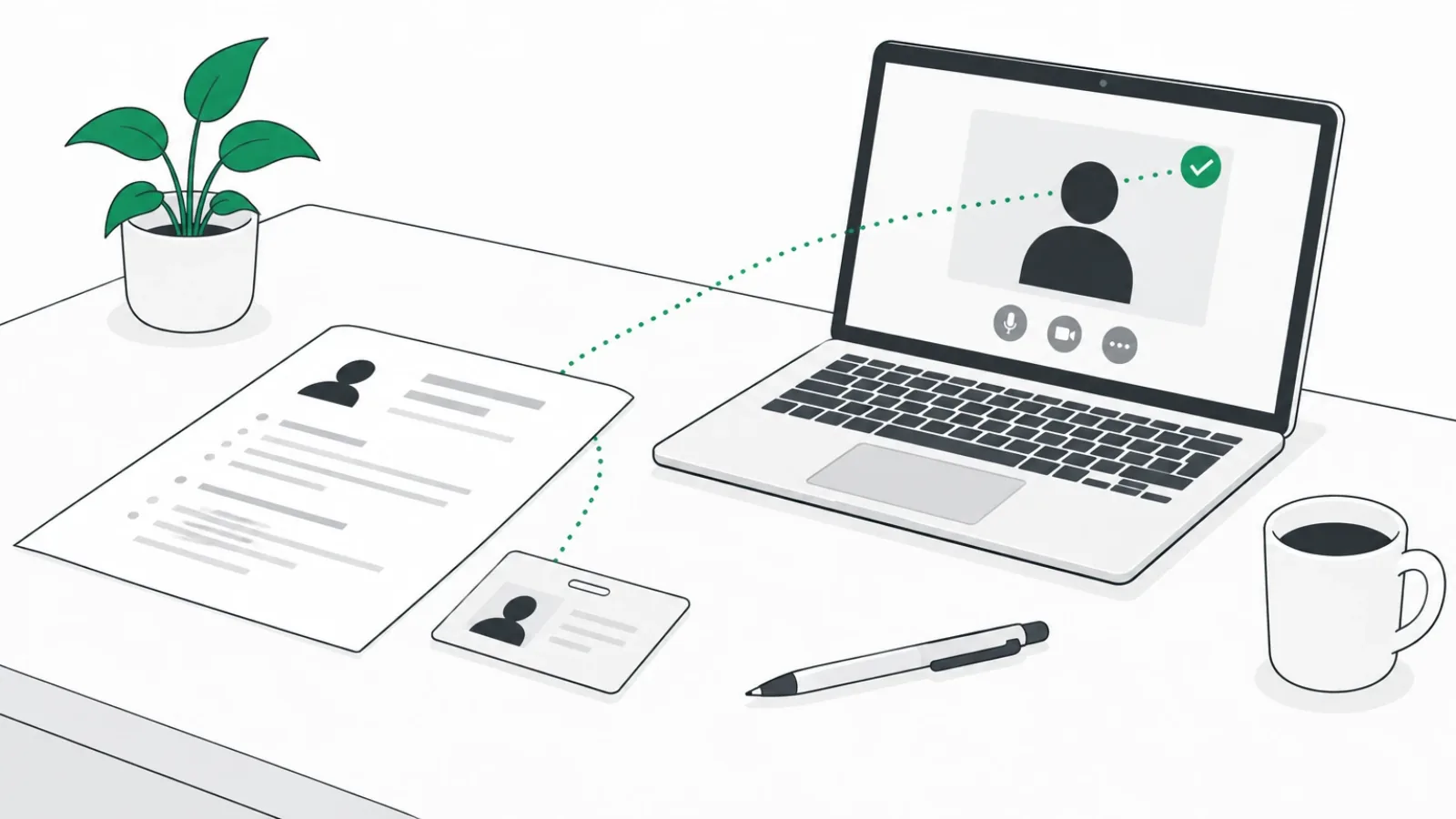
Candidate fraud is when the person applying or interviewing is not who, or what, they claim: a borrowed identity, a stand-in, an altered face or voice, or hidden help with answers. Detection works in layers: the application, the identity, the live call and day one.
On this page
Key takeaways
- Five types. A borrowed identity, a stand-in, a face swap, hidden AI help and organised schemes each need a different check.
- Four layers. The application, the identity, the live call and day one. No single layer covers every type.
- An ID check confirms a document. It does not confirm who is answering on the call an hour later.
- Ask for counts. Any check should show how often it catches the problem and how often it flags an honest person.
Hiring teams use the phrase "candidate fraud" for a wide set of problems, from a padded resume to an organised scheme. This post narrows it to what a hiring process can check: is this the person who applied, is that their real face and voice, and are the answers their own. It covers the types, how common they are, and where in the process each one can be caught.
What candidate fraud means
Gartner's survey gives the narrow version. HR Dive reported that "In a survey of 3,000 job candidates, 6% said they participated in interview fraud, either by posing as someone else or having someone else pretend as them."
Gartner also made a prediction: by 2028, 1 in 4 candidate profiles worldwide "could be fake". It is a forecast, not a measurement. Gartner advises a "multi-layered fraud mitigation strategy", including in-person interviews and post-hire "system-level validation". Our statistics guide keeps the numbers and how each was measured.
Five types of candidate fraud
| Type | What it looks like | Deep dive |
|---|---|---|
| Borrowed or invented identity | A real person's details, or a profile built for the job | Red flags across the hiring process |
| Stand-ins and proxy interviews | Someone else answers, on camera or off | Proxy interviews |
| Face swaps and camera software | A different face sent into the call through camera software | Face swaps and virtual cameras |
| Hidden AI answer help | Answers from a tool hidden from screen sharing | Interview cheating tools |
| Organised schemes | Workers placed under other identities, with company laptops kept in laptop farms | North Korean IT workers |
Most of these are not new. The FBI warned in 2022 of "the use of deepfakes and stolen Personally Identifiable Information (PII) to apply for" remote jobs. In June 2025 the US Justice Department said North Korean IT workers had obtained jobs at "more than 100 U.S. companies", and that agents searched "29 known or suspected 'laptop farms'" across 16 states.
How common it is
- Managers. In Checkr's 2026 survey, 40% "have interviewed a candidate later found to be using a fake identity, up from 31% in 2025", and "just 23% of managers are extremely confident their hiring process would catch a fraudulent candidate". It is a vendor survey of 3,000 US managers involved in hiring, fielded September 11 to 16, 2026.
- Candidates. 6% of 3,000 candidates in Gartner's survey said they had taken part, by their own account.
- Assessments. CodeSignal's attempt rate on proctored assessments rose from 16% in 2024 to 35% in 2025 (vendor data). Its categories include "proxy test-taking" and "identity fraud".
In the same Checkr survey, 68% of managers believe "candidates are better at faking their identities with AI than companies are at detecting them."
Where to check: four layers
No single check covers every type. An ID check confirms a document; it does not confirm who is answering on the call an hour later. Each layer below catches something the others miss.
| Layer | What it checks | Examples |
|---|---|---|
| 1. Application | Signals on the application: device, network, email, phone, details reused across applicants | Ashby runs applicants "through multiple fraud checks as they apply", using Device, IP, Email and Phone signals, on all plans. The FBI advises cross-checking HR systems "for other applicants with the same resume content and/or contact information". |
| 2. Identity | That a real document matches a real face | Greenhouse with CLEAR: "an integrated approach to identity that matches a candidate's selfie to their government-issued ID", launched "for select customers starting in Q3 2025". Persona offers candidate verification that integrates with Ashby. |
| 3. Live call | That the person on the call is real, on a real camera, with no hidden helper | Verified Call checks for camera software, someone else's face or voice, and hidden AI tools, and never joins the call. Results are below. |
| 4. Onboarding and day one | That the person who starts is the person you hired | The FBI recommends completing "as much of the hiring and onboarding process as possible in person", and watching for "changes in address or payment platforms during the onboarding process". |
Each layer has its own blind spot. Ashby's docs say it plainly: "A successful check does not mean there was no fraud." The FBI's 2025 advice spans every layer: "Implement identity-verification processes during interviewing, onboarding, and throughout the employment of any remote worker".
Signals the FBI lists
The FBI's public warnings list signs worth knowing. None is proof on its own; each is a reason to look closer.
- On video, the "lip movement of the person seen interviewed on-camera do not completely coordinate with the audio", and "coughing, sneezing, or other auditory actions are not aligned with what is presented visually" (2022).
- Use of "artificial intelligence and face-swapping technology during video job interviews" (2025).
- "reused phone numbers (particularly voice-over-IP numbers) and email addresses" (2025).
- "changes in address or payment platforms during the onboarding process" (2025).
The FBI also suggests "soft" interview questions about where the candidate is. For a fuller list of signs at each stage, see red flags before, during and after the interview, and for identity checks on video, how to verify a candidate's identity.
What Verified Call adds on the live call
Verified Call works on the live-call layer. It never joins the call. It plugs into the calls you already run. Google Meet today, actively expanding to Zoom and Teams. We publish how each check was tested.
| Check | Result | Sample |
|---|---|---|
| Camera software | 29 of 29 tries each | 9 kinds of camera software and 7 direct cameras |
| Live calls read right | 20 of 20 calls | 10 direct cameras, 10 face swaps sent through camera software |
| Someone else's face | 0 of 3,990 sessions got through (2,855 flagged, 1,135 ended "Can't confirm") | Public research video of 70 people, tested offline |
| The real person's face | Cleared in 99.2% of sessions (962 of 970) | Public research video of 70 people, tested offline |
| A different person's voice | Not confirmed in 87.0% of tries (191,277 of 219,821) | Public recordings of phone calls in 8 Indian languages, from 1,134 people, tested offline (not live calls) |
| The real person's voice | Confirmed in 95.35% of tries (7,916 of 8,302) | Same recordings |
| Hidden AI tools | 30 of 30 tries, for each of 4 tools; 0 of 30 false alarms with no AI tool open, 0 of 30 with everyday apps open | 4 free AI answer tools (Interview Coder, OpenCluely, Pluely and Cheating Daddy) |
Results are advice for the host, not a verdict on a person. Every result, with its date and conditions, is on the Research page. No other tool publishes its research or test data. We do, false alarms included.
Questions to ask any vendor
- Which layer does it cover: the application, the identity, the live call or day one?
- How often does it catch the problem, as a count, and how often does it flag someone who did nothing wrong?
- Does it join the call, and what does the candidate have to do?
- Was it tested on live calls or on recordings, and when?
To compare vendors by approach, see cheating detection tools for interviews. To judge a vendor's evidence, see how interview integrity tools are tested.
Questions hiring teams ask
What is candidate fraud?
It is when the person applying or interviewing is not who, or what, they claim: a borrowed identity, a stand-in, a face or voice altered on video, or hidden help with the answers. In a Gartner survey of 3,000 candidates, 6% said they had posed as someone else or had someone pose as them.
What are the main types of candidate fraud?
Five: a borrowed or invented identity, stand-ins and proxy interviews, face swaps and camera software, hidden AI answer help, and organised schemes such as North Korean IT worker operations.
What is the difference between candidate fraud detection and a background check?
A background check confirms records about a named person. It does not confirm that the person on the video call is that person, or that the answers are their own. Checks during the interview cover that part.
Do ATS tools like Ashby or Greenhouse detect candidate fraud?
Ashby runs new applicants through checks using device, IP, email and phone signals, on all plans, and its docs say a passed check is not proof that nothing is wrong. Greenhouse offers identity checks with CLEAR, matching a selfie to a government ID. Both act on the application or the identity, before the live interview.
Sources
- HR Dive“By 2028, 1 in 4 candidate profiles will be fake, Gartner predicts”August 8, 2025
- CheckrThe Hiring Hoax 2026 (survey of 3,000 US managers, fielded September 11 to 16, 2026)October 15, 2026
- CodeSignal“Detection systems identify and stop record-high cheating attempts as assessment fraud more than doubled in 2025”February 25, 2026
- FBIPublic Service Announcement I-062822-PSAJune 28, 2022
- FBIPublic Service Announcement I-012325-PSAJanuary 23, 2025
- US Department of JusticeCoordinated, nationwide actions to combat North Korean remote IT worker schemesJune 30, 2025
- Ashby“Introducing fraudulent candidate detection and management”September 16, 2025
- Ashby docs“Running candidate fraud detection checks and reviewing fraud signals”Read November 6, 2026
- CLEARCLEAR and Greenhouse announce partnershipJune 12, 2025
- PersonaPersona and Ashby integrationDecember 2, 2025
- Verified Call researchPublished test results, with dates and conditionsUpdated October 26, 2026
See the checks on a real call
Book a short demo and we will show the checks on a live call, with the proof the host sees.
Related reading
 IdentityHow to verify a candidate’s identity in a video interviewConfirm who applied, then confirm the same real person is on a real camera, without a helper, for the whole call.
 Stand-insProxy interview detection: who is really answering?A proxy interview is when a different person answers or helps. Learn the signs, why they mislead, and how to confirm the same face and voice through the whole call.
 DataInterview integrity statistics 2026: AI help, stand-ins and deepfake candidatesSourced numbers on AI help in live interviews, stand-ins, false identities and deepfake candidates, each with its publisher, sample and date.