
North Korean IT workers: how they get hired, and how to check
North Korean IT workers use stolen or borrowed identities to win remote tech jobs, then route pay to the regime. US facilitators keep company laptops online in laptop farms and some sit interviews for them. The FBI tells employers to verify identity throughout hiring and keep cameras on.
On this page
Key takeaways
- It is large. One set of DOJ cases covered more than 100 US companies; Treasury says the scheme raised nearly $800 million in 2024.
- The interview is a target. The FBI has seen face swaps in video interviews and paid US facilitators sitting interviews.
- No single tell. The FBI says to layer checks through hiring and employment: "identity in depth".
- Check facts, not people. Identity, devices and the same person across calls; never accent, name or nationality.
This is the hiring team's version of a security story. It sets out how big the scheme is, how it runs, what changed in 2025 and 2026, the signs at each hiring stage, and what the FBI and security researchers have told employers to do. Every fact links to its source below.
How big it is
- 100+
- US companies where workers got remote jobs in one set of cases (US Justice Department, June 2025)
- 309
- US businesses affected in one laptop-farm case (US Attorney's Office, July 2025)
- ~$800M
- in revenue for the regime in 2024, by the US Treasury's count (March 2026)
In the June 2025 actions, the Justice Department said the workers had "compromised the identities of more than 80 U.S. persons", that agents carried out "searches of 29 known or suspected "laptop farms" across 16 states", and that one set of cases caused "damages and losses of at least $3 million". In the Arizona case, a US facilitator was sentenced to 102 months in prison; the release lists "68 U.S. person identities stolen" and "more than $17 million in illicit revenue". That figure is revenue for the scheme, not victims' losses.
Security researchers describe the same scale. Microsoft says "North Korea has deployed thousands of remote IT workers" and cites a US government finding of "over 300 US companies in multiple industries" affected from 2020 to 2022. CrowdStrike says it investigated 320 North Korean IT worker cases in a year, a 220% rise, by its own data. Amazon's security chief said the company had blocked 1,800 suspected North Korean applicants, as AFP reported in December 2025.
How the scheme works, step by step
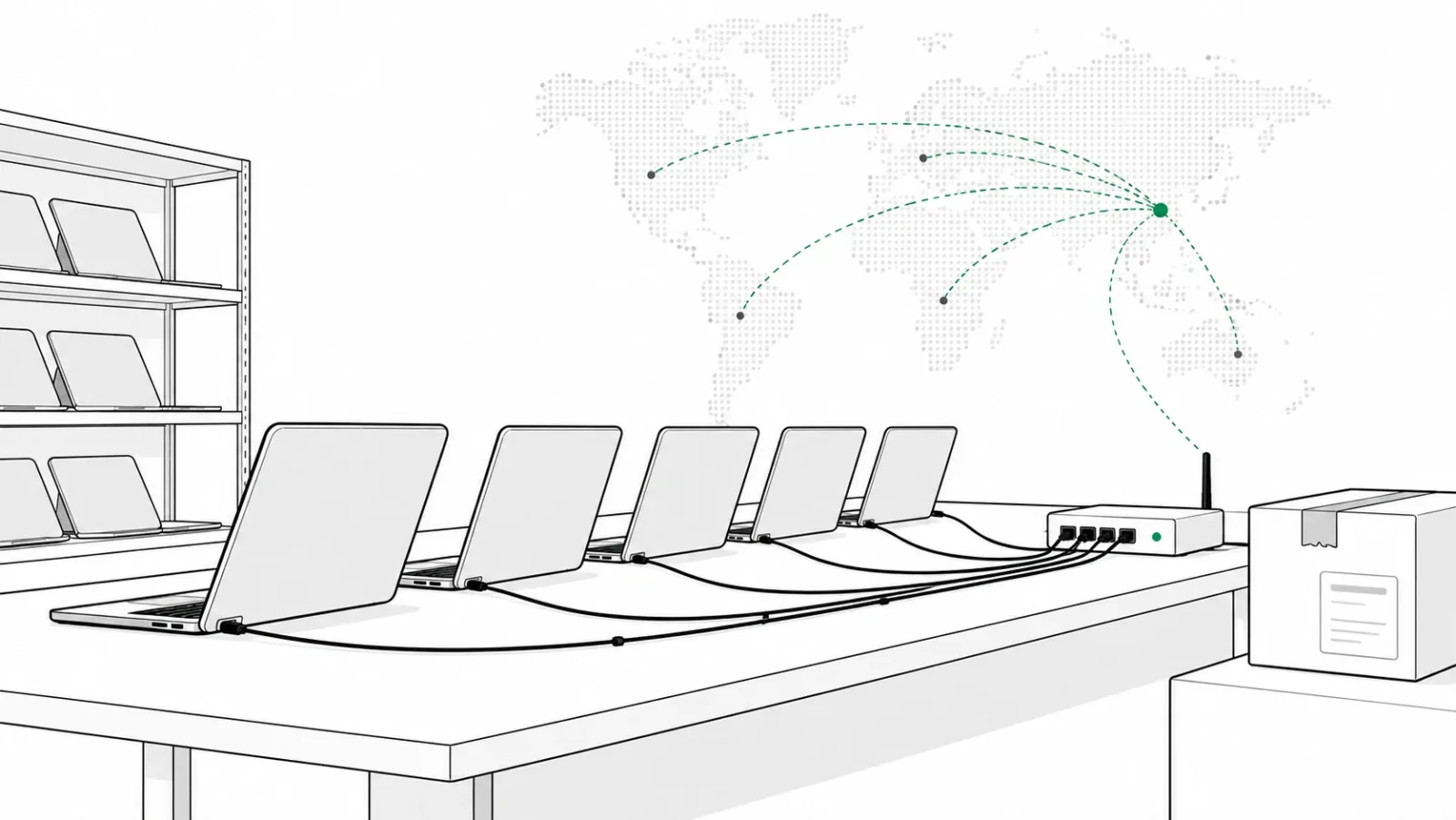
Treasury says the workers "rely on fraudulent documentation, stolen identities, and fabricated personas". The FBI has described US facilitators taking part in "Attendance at virtual interviews and meetings on behalf of" the workers, and in October 2026 warned of Americans paid "to appear on camera, participate in job interviews or meetings". Once hired, the laptop goes to a US address, where facilitators keep it online, sometimes with "keyboard-video-mouse or "KVM" switches" so it can be used remotely.
The person who interviews is not always the person who works. The FBI warns that "the on-the-job work is completed by a different individual". Microsoft describes one worker who "has never been seen on camera during a video telecommunication session", and others using "voice-changing software".
What changed in 2025 and 2026
- AI in the interview. In January 2025 the FBI warned of workers "using artificial intelligence and face-swapping technology during video job interviews".
- Data extortion. The same advisory was titled "North Korean IT Workers Conducting Data Extortion".
- Europe. Google's threat team found one worker had "operated at least 12 personas across Europe and the United States" (April 2025).
- Cheap deepfakes. A Palo Alto Networks Unit 42 researcher "created a synthetic identity for job interviews in 70 minutes" as a test (April 2025). Okta found workers using AI to "Conduct mock job interviews via chat and webcam".
- More people on camera. In October 2026 the FBI described "thousands of state-controlled remote "IT Workers"" and more paid US facilitators, including people who appear on camera for them.
Signs hiring teams can check, by stage
Application
- Reused phone numbers, often voice-over-IP, and reused email addressesFBI, January 2025
- Resume typos and unusual namingFBI, January 2025
Interview
- Camera kept off, or a background they will not showFBI, July 2025; Microsoft, June 2025
- "increased noise during interviews"FBI, May 2024
- Video that breaks up when a hand passes in front of the faceFBI, July 2025
Offer
- Address changes after hire, before the laptop shipsFBI, May 2024
- A laptop asked to go anywhere but the address on the IDFBI, July 2025
First weeks
- Remote-access software or KVM devices on company equipmentFBI, July 2025; DOJ, June 2025
- Frequent bank account changesFBI, July 2025
- A different person doing the workFBI, July 2025
ITWs cannot be identified reliably with a single indicator
No row on its own is a finding. The FBI's answer is "identity in depth": several checks, repeated, rather than one test at the start.
What employers were told to do
- Do more in person. "Complete as much of the hiring and onboarding process as possible in person." (FBI)
- Verify identity throughout. Use "identity-verification processes during interviewing, onboarding, and throughout the employment" (FBI).
- Cameras on, from the first call. "Mandate video and request that their backgrounds be unobscured." (FBI). Unit 42 adds: turn cameras on "including initial consultations".
- Use simple live checks. Ask the person to "wave their hand in front of their face" if the video looks odd (FBI).
- Compare across calls. "Capture images for comparison with future meetings." (FBI). Mandiant suggests "periodic mandatory spot checks where remote employees are required to go on camera".
- Control equipment. The FBI says to "only send to the address listed in the employee's identification documents", and to watch for unapproved remote-access tools.
- Confirm history directly. Check "prior employment and higher education history directly" (FBI).
- Stay alert. The Justice Department and FBI "ask all U.S. companies that employ remote workers to remain vigilant".
Why manual checks alone are hard
Each of these checks depends on someone remembering to do it, on every call. A stand-in can pass the interview and hand over the job. A Unit 42 researcher built a real-time deepfake in "just over an hour with no prior experience". And KnowBe4, a security company, hired one of these workers after "four video conference based interviews on separate occasions", by its own account.
Where Verified Call fits
Verified Call checks the person on the call, before it starts and while it runs, without joining. It checks for hidden AI answer tools, camera software, face swaps, deepfakes and AI avatars sent through camera software, and someone else answering. It checks that the voice on the call matches the person who did the check.
It works inside the video calls you already run. No bot in the participant list. It checks on the person's own computer, so it sees what a video call cannot carry: a tool hidden from screen sharing, or a face sent in through camera software. Each call is checked fresh. The host sees a plain result, with proof beside any flag, and a person can decline the check and still join with the host's link; the host sees that they declined.
We publish how we test, false alarms included. In our own testing, each of 4 hidden AI answer tools was found in 30 of 30 tries, with 0 of 30 false alarms with no AI tool open and 0 of 30 with everyday apps open (October 4, 2026). Camera software and direct cameras were read right in 20 of 20 live calls (October 2, 2026). Every condition is on the Research page.
Related checks are covered in proxy interviews, deepfake candidate detection and how to spot fake candidates.
Fair to candidates
These schemes are a state operation. They are not a reason to treat applicants with a particular accent, name or background differently, and doing so would wrong honest candidates. Check facts: identity, devices, and that the same person stays on the call. A flag is a reason for a calm follow-up question.
Focus on detecting fraud and misrepresentation, not stereotypes.
For industry numbers on stand-ins and false identities, see the interview integrity statistics.
Frequently asked questions
How many companies have hired North Korean IT workers?
One set of US Justice Department cases covered more than 100 US companies (June 2025). The Arizona laptop-farm case covered 309 US businesses. Microsoft cites a US government finding of more than 300 US companies from 2020 to 2022.
What is a laptop farm?
A US home where a facilitator keeps company laptops online so workers abroad can use them remotely, sometimes through keyboard-video-mouse (KVM) switches.
Do they use deepfakes in interviews?
The FBI says they have used artificial intelligence and face-swapping technology during video job interviews, and Microsoft reports voice-changing software.
Can someone else sit the interview for them?
Yes. The FBI lists facilitators attending virtual interviews on the workers' behalf, and warns that a different person may do the job after hire.
What did the FBI tell employers to do?
Verify identity throughout hiring and employment, keep video on with backgrounds visible, compare images across meetings, ship laptops only to the address on the ID, and do as much as possible in person.
Is there a single tell?
No. The FBI says these workers cannot be identified reliably with a single indicator. Look for a pattern and check the facts behind it.
How much money does this raise?
The US Treasury says nearly $800 million in 2024.
How do we check without treating honest candidates unfairly?
Check facts such as identity, devices and the same person across calls, never accent, name or nationality. Treat any flag as a reason for a calm follow-up.
Sources
- US Department of JusticeCoordinated, nationwide actions to combat North Korean remote IT worker schemesJune 30, 2025
- US Attorney's Office, District of ColumbiaArizona woman sentenced in $17M IT worker scheme (press release)July 24, 2025
- US TreasuryPress release sb0416March 12, 2026
- FBIPublic Service Announcement I-101326-PSAOctober 13, 2026
- FBIPublic Service Announcement I-072325-4-PSAJuly 23, 2025
- FBINorth Korean IT Workers Conducting Data Extortion (I-012325-PSA)January 23, 2025
- FBIPublic Service Announcement I-051624-PSAMay 16, 2024
- Microsoft Threat IntelligenceJasper Sleet: North Korean remote IT workers' evolving tacticsJune 30, 2025
- Google Cloud, MandiantMitigating the DPRK IT worker threatSeptember 23, 2024
- Google Threat Intelligence GroupDPRK IT workers expanding in scope and scaleApril 1, 2025
- Palo Alto Networks Unit 42North Korean synthetic identity creationApril 21, 2025
- Okta Threat IntelligenceGenAI and DPRK IT workersApril 24, 2025
- CyberScoopReporting CrowdStrike's 2025 Threat Hunting ReportAugust 2025
- The Star (AFP)Amazon says blocked 1,800 North Koreans from applying for jobsDecember 23, 2025
- KnowBe4“How a North Korean fake IT worker tried to infiltrate us”July 23, 2024
- Security Alliance (SEAL)DPRK IT workers frameworkRead October 29, 2026
See it on a real call
Book a short demo and we will show the checks on a live call, with the proof the host sees.
Related guides
 IdentityHow to spot fake candidates in remote interviewsSigns before, during and after the interview, the FBI's live checks, and a 12-step checklist from application to day one.
 IdentityHow to verify a candidate’s identity in a video interviewConfirm who applied, then confirm the same real person is on a real camera, without a helper, for the whole call.
 DeepfakesDeepfake candidate detection in video interviewsHow a deepfake candidate, face swap or AI avatar reaches a video interview, why watching is not enough, and how you'll know before you hire.