
How to verify a candidate’s identity in a video interview
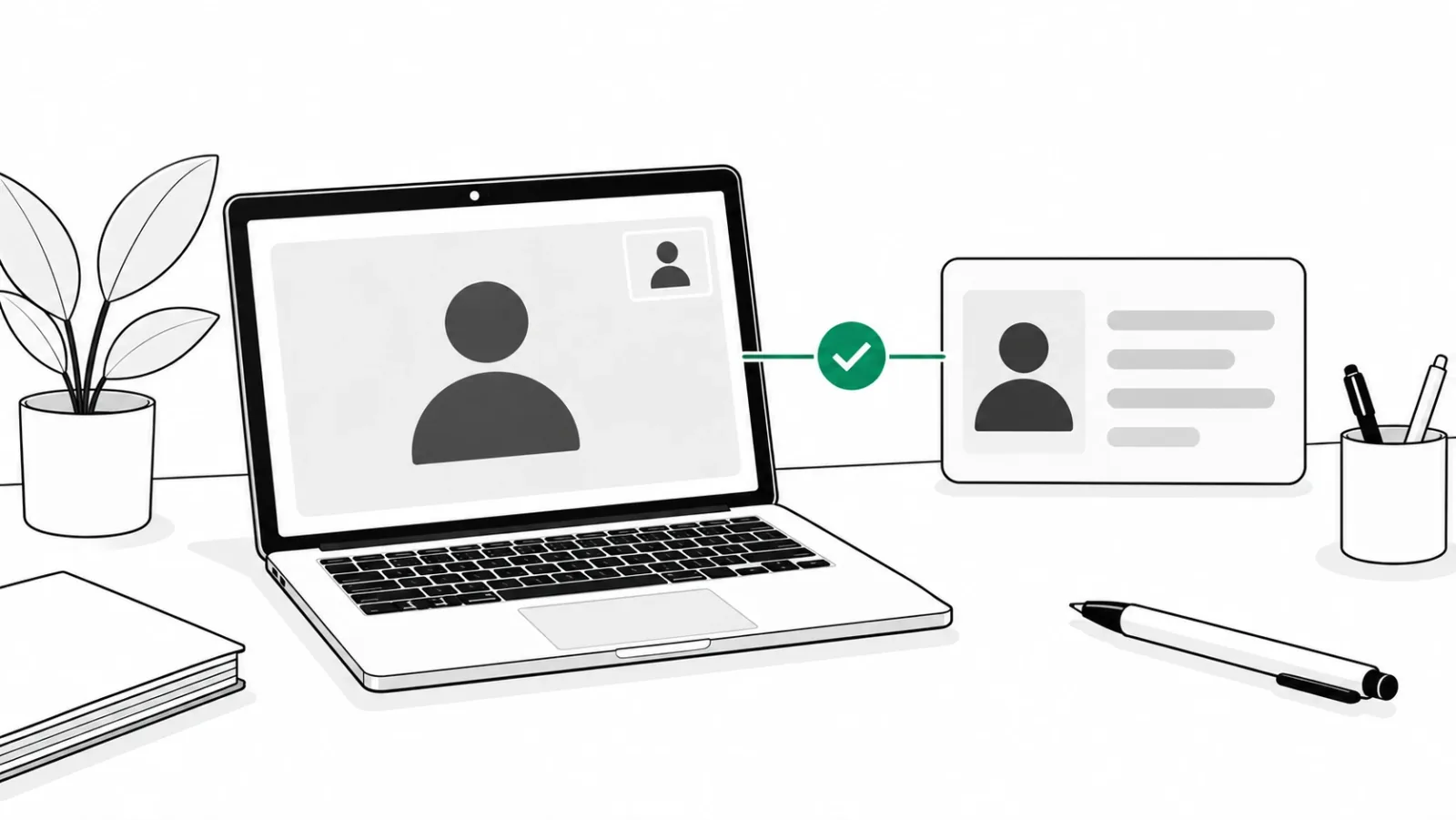
To verify a candidate's identity in a video interview, confirm two things: that the person matches who applied, and that the person on the call is the same real person, on a real camera, for the whole interview. An ID check answers the first question.
On this page
Key takeaways
- Two questions. Does the person match who applied, and is that same real person on the call for the whole interview?
- An ID check answers the first. A check on the call answers the second, where stand-ins and face swaps get through.
- Steps by hand help. Cameras on, compare rounds, ask about their own history; each depends on someone noticing.
- Fair to the candidate. Consent first, a fresh check every interview, and results are advice, not a verdict.
A check on the call itself answers the second.
Most hiring teams already do the first part somewhere in the process. The second part is newer, and it is where stand-ins, face swaps and hidden helpers get through.
Two different questions
| Question | What answers it | When |
|---|---|---|
| Is this applicant a real person with this name? | An ID document check, background check or I-9 | Usually once, often after the offer |
| Is the person on this call that same real person, on a real camera, without a helper? | A check on the call: camera, face and the computer behind it | Every interview, before and during the call |
The gap between the two is real. One recruiter on r/recruiting described a hire who "passed the background check, I9, everything", and then a different person appeared on camera on day one (August 2026). In Checkr's 2025 survey of 3,000 US hiring managers, 35% said someone other than the listed applicant had taken part in a virtual interview. More numbers are on the interview integrity statistics page.
Steps you can take by hand
- Keep cameras on for every round, and say so in the invite.
- Compare across rounds. Note the face and voice in the first screen and check they match in later rounds.
- Ask about their own history. Questions that build on the resume and on their earlier answers are hard for a stand-in to follow.
- Use an ID check where your process needs one, handled by a service built for documents, not a photo of an ID held up to the camera.
- Bring in one in-person or ID-checked meeting for roles with access to sensitive systems.
These steps help, but each one depends on an interviewer noticing something and remembering to check. Face swaps follow head turns well, a helper off camera leaves little trace, and an ID shown once at the start says nothing about who answers later.
Checking the call itself
A check on the call looks at the facts a video cannot show:
- Camera software. A direct camera, or camera software that can carry a face swap or an AI avatar.
- Whether the face stays the same. Checked again and again through the call, so a hand-over halfway is seen.
- Whether a hidden helper is running. AI tools in windows hidden from screen sharing.
How Verified Call does it
Verified Call checks the person on a video call, before and during it, without joining. The candidate gets a link that opens 10 minutes before the call, agrees on a consent screen, and runs the Verified Call app for a few quick checks, about five minutes. During the call the app keeps checking the camera, the face and the computer. The host sees a badge next to the candidate in the call: Verified, Needs a look with the proof beside it, or Can't confirm.
Verified Call checks the call rather than the document, so it fits next to the ID check you already use: the ID check confirms who applied, and Verified Call confirms that person is the one on the call.
- 0 of 3,990
- sessions with someone else's face got through, on recordings of 70 people (October 1, 2026)
- 99.2%
- of 970 sessions with the real person cleared (October 1, 2026)
Of the sessions with someone else's face, 2,855 were flagged and 1,135 ended "Can't confirm". In 20 of 20 live calls the camera check read right (October 2, 2026). The method is on the Research page.
Fair to the candidate
- The candidate agrees on a consent screen before anything starts, and can decline and still join. The host sees that they declined.
- Each interview gets a fresh check. Nothing is carried over.
- Results are advice for the host, not a verdict. "Can't confirm" is not an accusation.
- Call results are deleted about 7 days after the last activity. Details are in the privacy policy.
Frequently asked questions
How do you verify a candidate's identity in a video interview?
Confirm who applied with an ID or background check, and confirm the person on the call with a check on the call itself: a real camera, the same face throughout, and no hidden helper. Verified Call does the call check in the call itself, before and during the interview.
Is asking a candidate to hold up an ID on camera enough?
It helps a little, but it shows a document once, through the same video that a face swap can change. It says nothing about who answers later in the call. A continuous check on the call covers that.
Can someone pass an ID check and still have someone else interview?
Yes. An ID check confirms a document, often after the offer. A different person can sit the interview, or a helper can feed answers. Checking the face and camera during each interview closes that gap.
What is candidate impersonation?
Candidate impersonation is when someone other than the applicant takes part in the interview, on camera or off it. In India it is often called a proxy interview.
Does Verified Call check ID documents?
Verified Call checks the call rather than the document. It confirms the person on the call is on a real camera, with the same face throughout, without a hidden helper. Teams use it next to their ID check.
See it on a real call
Book a short demo and we will run the check on a live call and answer your questions as we go.
Related guides
 Stand-insHow staffing and nearshore firms stop proxy candidatesFor owners of remote developer staffing firms: what to check at each stage, what to do when you suspect a proxy but cannot prove it, and what to do after the hire.
 Stand-insProxy interview detection: who is really answering?A proxy interview is when a different person answers or helps. Learn the signs, why they mislead, and how to confirm the same face and voice through the whole call.
 DeepfakesDeepfake candidate detection in video interviewsHow a deepfake candidate, face swap or AI avatar reaches a video interview, why watching is not enough, and how you'll know before you hire.