
Cluely vs Interview Coder: how hiring teams catch them
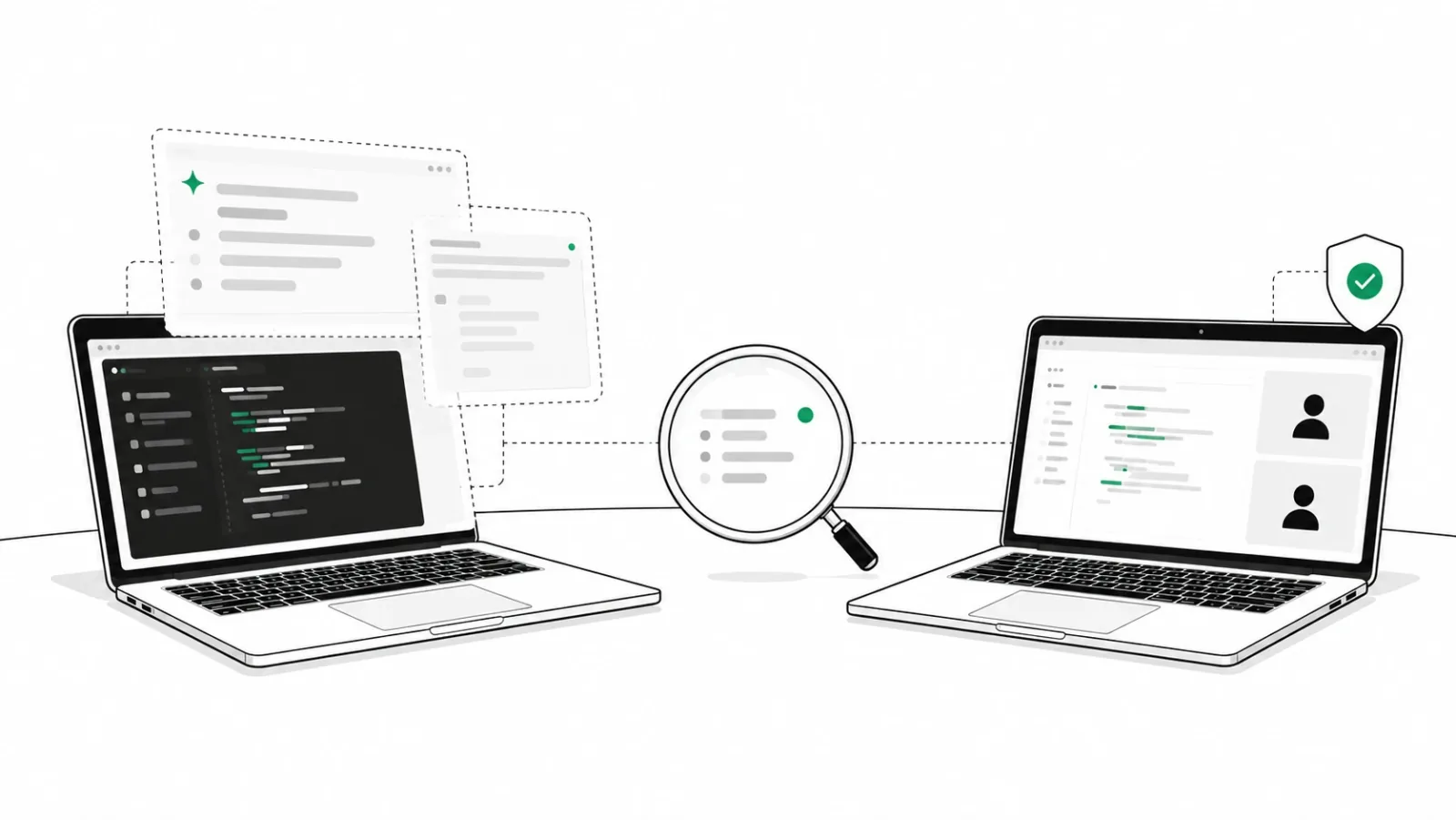
Cluely and Interview Coder show AI answers in a window that, by their own claims, screen sharing does not capture. Video platforms show what the person shares, so the window does not appear. Hiring teams use four approaches: behavior review, test platforms, a check on the candidate's computer, in-person rounds.
On this page
Key takeaways
- Same founders, same promise. Interview Coder came first; Cluely followed and now calls itself a meeting note-taker.
- Funded. A $5.3 million seed (April 2025) and a $15 million Series A led by Andreessen Horowitz (June 2025).
- Detection is not settled. Interview Coder's own blog says no real-time tool can promise zero detection risk.
- Four approaches, different reach. Behavior review, test platforms, a check on the candidate's computer and in-person rounds each catch different things.
Both tools come from the same founders, both sell the same promise, and both are easy to miss on a video call. This page puts their own claims side by side, lists Cluely's funding round by round, and compares the four ways hiring teams catch them.
Cluely vs Interview Coder
| Cluely | Interview Coder | |
|---|---|---|
| What it says it is | Today's page title: "Undetectable AI Notetaker & Meeting Assistant" | "a desktop app designed to help job seekers ace technical interviews" |
| What it says about being seen | "Invisible to screen share." | "100% Invisible to Screen-Recording" |
| What it says about testing | No claim found on its home page | "tested every single day against every single interview software" |
| Who built it | Roy Lee and Neel Shanmugam | The same founders, who were suspended from Columbia University for developing it |
| Positioning | Launched to "cheat on everything"; now calls itself a meeting note-taker | Technical interviews |
Quotes are from each company's site, read on October 29, 2026, and from TechCrunch. They are the companies' claims, not test results.
What the tools are, and what they claim
TechCrunch reported in June 2025 that Cluely's founders "were suspended from Columbia University for developing an undetectable AI-powered tool": Interview Coder. Cluely followed, and TechCrunch described it as a tool that "claims to help users "cheat" on job interviews, exams, and sales calls". Its manifesto is still live and says: "We want to cheat on everything."
By March 2026, TechCrunch reported, "Cluely has since rebranded itself as an AI-powered meeting note-taker." Its home page still says "Invisible to screen share." and that it "gives real-time answers, all while completely undetectable".
Interview Coder's site makes the same kind of promise for coding interviews. It also claims "10,000+ Candidates cracked Job Offers by using Interview Coder", a figure we could not verify. Who runs Interview Coder today is not clear from public sources, so we do not say.
Both rely on the same trick, shown in pictures in how hidden AI interview helpers stay invisible, in their own words.
Cluely’s funding, round by round
| Round | Amount | Led by | Reported |
|---|---|---|---|
| Seed | $5.3 million | Co-led by Abstract Ventures and Susa Ventures | TechCrunch, April 21, 2025 |
| Series A | $15 million | Andreessen Horowitz | TechCrunch, June 20, 2025 |
TechCrunch also reported that two investors not in the deal "believe Cluely's post-money valuation is around $120 million". That is an outside estimate; Andreessen Horowitz declined to comment.
Interview Coder detected? What is said in public
People search for "interview coder detected" because the answer is not clear-cut. Here is what each side has said:
- Interview Coder's own blog admits limits: "No real-time tool can honestly promise zero detection risk". Its FAQ asks why it is visible on Google Meet with Windows 10.
- Cluely's CEO told TechCrunch in July 2025: "We don't care if we're able to be detected or not." He added: "The invisibility function is not a core feature of Cluely."
- Detector startups launched in April 2025. Validia says its tool "triggers an alarm if it detects someone using Cluely". Proctaroo's CEO said "we can see running applications and 'hidden' background processes".
- HackerRank documents a Desktop App Mode, part of its paid AI Add-on for HackerRank tests, that names "invisible cheating tools such as Cluely and Ultracode".
No real-time tool can honestly promise zero detection risk
Why screen sharing misses these windows is explained in how to detect Interview Coder, Parakeet AI and Otter. For Cluely on its own, see how to detect Cluely.
Four ways hiring teams catch them
| Approach | Hidden answer window | Phone or second device | Camera software or face swap | Cost to the team |
|---|---|---|---|---|
| Behavior review (timing, eyes, answer style) | Sometimes, indirectly | Sometimes | No | Low, but flags nervous and second-language candidates too |
| Locked-down test platform | Inside that test, per the vendor's docs; HackerRank's mode is a paid add-on | Partly | Not claimed in the docs we found | Medium: an install, only for that test |
| Check on the candidate's computer during the call (for example Verified Call, Zero Assist) | Checks for hidden AI answer tools | Not the main target | Verified Call checks for camera software and face swaps | Low to medium: one install, with consent |
| In-person round | Yes | Yes | Yes | High: travel, cost, slower hiring |
Many teams mix them. Google's CEO said on the Lex Fridman Podcast in June 2025 that Google added "at least one round of in-person interviews", "just to make sure the fundamentals are there". Behavior review is the cheapest and the riskiest for honest candidates. Fabric is a vendor of AI-run interviews, and its numbers are its own flags, not confirmed cases: it reports "38.5% of all candidates flagged for cheating behavior" in 19,368 of its AI interviews from July 2025 to January 2026, at its own threshold, and it publishes no false-alarm rate.
Other tools sold the same way include Final Round AI, LockedIn AI and Parakeet AI.
Where Verified Call fits
Verified Call checks the person on the call, before it starts and while it runs, without joining. It checks for hidden AI answer tools, camera software, face swaps, deepfakes and AI avatars sent through camera software, and someone else answering. It checks that the voice on the call matches the person who did the check.
It works inside the video calls you already run. No bot in the participant list. It checks on the person's own computer, so it sees what a video call cannot carry: a tool hidden from screen sharing, or a face sent in through camera software. Each call is checked fresh. The host sees a plain result, with proof beside any flag, and a person can decline the check and still join with the host's link; the host sees that they declined.
We publish how we test, false alarms included. In our own testing, each of 4 hidden AI answer tools was found in 30 of 30 tries, with 0 of 30 false alarms with no AI tool open and 0 of 30 with everyday apps open (October 4, 2026). Camera software and direct cameras were read right in 20 of 20 live calls (October 2, 2026). Every condition is on the Research page.
Questions to ask any tool, including us, are in ask for the false-alarm rate. Industry numbers are on the statistics page.
Frequently asked questions
What is Cluely?
A desktop AI assistant that shows answers in a window it says is invisible to screen share. It launched with a "cheat on everything" pitch and has since rebranded as an AI meeting note-taker, according to TechCrunch.
Cluely vs Interview Coder: what is the difference?
Interview Coder targets technical interviews. Cluely is a general meeting assistant that started with interviews, exams and sales calls. Both say their windows stay out of screen sharing.
How much has Cluely raised?
A $5.3 million seed co-led by Abstract Ventures and Susa Ventures (April 2025) and a $15 million Series A led by Andreessen Horowitz (June 2025), as TechCrunch reported.
Does HackerRank detect Cluely?
HackerRank's Desktop App Mode, part of its paid AI Add-on, names Cluely among the tools it addresses during a HackerRank test. It applies to its tests, not to live video interviews. See what HackerRank, CoderPad and Codility check.
Is an in-person round the answer?
It catches the most and costs the most. Google's CEO said Google added at least one in-person round. Many teams keep video interviews and add a check during the call instead.
Answered in other guides
Sources
- Cluelycluely.com home pageRead October 29, 2026
- CluelyManifestoRead October 29, 2026
- Interview Coderinterviewcoder.co home page and FAQRead October 29, 2026
- Interview CoderIs Cluely detectable? (2026)June 9, 2026
- TechCrunchColumbia student suspended over interview cheating tool raises $5.3M to cheat on everythingApril 21, 2025
- TechCrunchStartups launch products to catch people using AI cheating app CluelyApril 29, 2025
- TechCrunchCluely, a startup that helps cheat on everything, raises $15M from a16zJune 20, 2025
- TechCrunchWhy Cluely's Roy Lee isn't sweating cheating detectorsJuly 9, 2025
- TechCrunchCluely CEO Roy Lee admits to publicly lying about revenue numbers last yearMarch 5, 2026
- HackerRank Knowledge BaseDesktop App ModeUpdated about October 12, 2026
- FabricState of AI interview cheating in 2026January 14, 2026
- Lex Fridman PodcastSundar Pichai transcriptJune 2025
- Verified CallResearch: hidden AI toolsTested October 4, 2026
See it on a real call
Book a short demo and we will show the checks on a live call, with the proof the host sees.
Related guides
 Hidden AI toolsCan Cluely be detected in an interview?Why Cluely stays off screen share, the signs that mislead, and how to know a candidate is not reading AI answers before you hire.
 Hidden AI toolsCan Interview Coder be detected? Parakeet AI and Otter tooWhat each tool says it does, what you can and cannot see on a call, and how to check for them fairly.
 Buyer's guideCheating detection tools for interviews (2026)Compare 15 interview integrity tools by approach: candidate computer checks, call bots, interview platforms and deepfake detection. Honest fit for each.